


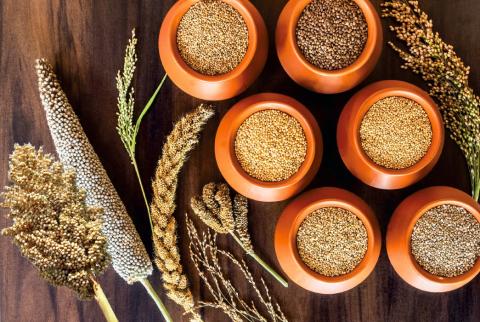
Introduction:
Indian Millets/Shree Anna consists of Sorghum (jowar), Pearl millet (bajra), Finger Millet (ragi) and Small Millets such as Banyard Millet, Proso Millet, Kodo Millet, Buckwheat, Amaranthus and Foxtail Millet. Millets are the excellent source of essential nutrients; they are also called as ‘nutritious Cereals’. The Indian Millets are nutritionally superior to wheat and rice, as they are rich in protein, vitamins, and minerals. They are also gluten-free and have a low glycemic index, making them ideal for people with celiac disease or diabetes.
Production:
Production of Shree Anna /Nutri Cereals is estimated to be 18.59 million tonnes in 2024-25. (DA&FW’s Final Estimate).
Area:
The major Shree Anna/Nutri Cereals producing states in India in 2024-25 are Rajasthan (29.86%), Maharashtra (13.62%), Karnataka (12.91%), Uttar Pradesh (12.67%), Gujarat (7.25%), Haryana (6.92%), Madhya Pradesh (5.87%), Tamil Nadu (4.34%), Andhra Pradesh (2.25%), and Telangana (2.11%).
Exports: During 2025-26, Millet exports from India stood at 138.69 thousand MT, valued at Rs. 543.40 Crore/USD 61.57 million.
Major Export Destinations (2025-26): UAE (22.4%), Saudi Arabia (12.7%), Nepal (7.8%), USA (6.7%), and Morocco (3.8%).
Source: DGCIS